
The Money Line, First Edition
Keep the work. Change the number.
- 1Name the number.
- 2Fund three bets.
- 3Read the proof.
A one-page way to write a strategy you can check. Out January 2027. Chapter 1 is free now: leave your email and it opens on this site right away, with Lesson 1 of the online course.
What comes with the book
- The illustrated book (PDF). The full book, 173 pages with its figures and boxes, also in a phone edition. It now includes a chapter on fitting the method beside the framework you already run.
- The One-Hour Read. The main text in 75 pages.
- The Casebook. All 18 full cases and 8 deeper boxes.
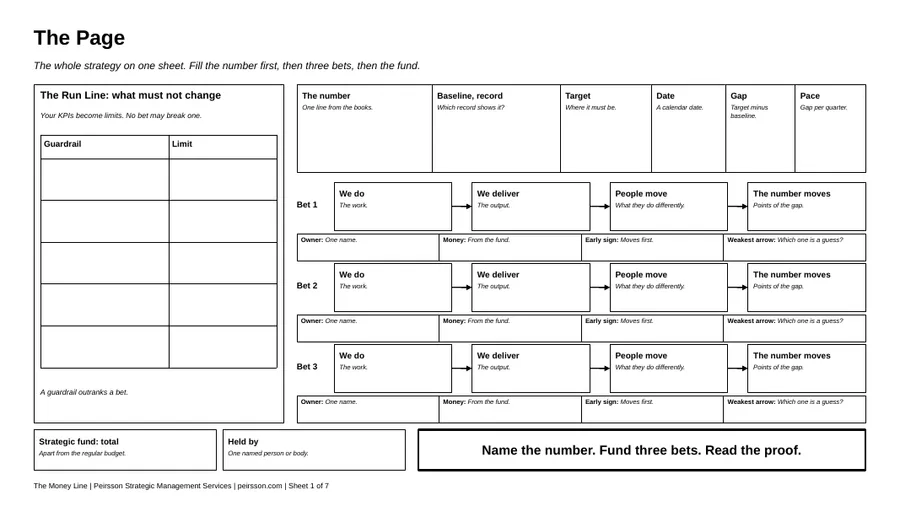
- The Page and six sheets (fillable PDF forms and PowerPoint). The whole strategy on one page, plus sheets for sorting, the number, the field, the bet card, the test card, and the review.
- The online course. How the Money Line Works: 9 self-paced text lessons with interactive exercises and short quizzes. Lesson 1 is free with the founding list.
Why one number and three bets beat a long list of goals
Open the last strategic plan your organization wrote. Count the items on it and ask what share are routine work under a new name. A repaint, a system upgrade, and a yearly event are good things to do, and they would happen anyway. A list like that feels safe because nothing on it can be wrong, and it never says which number must change.
The Money Line gives you a plug-in for strategy. Your operations stay as they are, with their measures, their budget, their departments, and their meetings. You add one number that must change, three bets that change it, and a fund that protects them. The numbers you already track do not disappear. They become guardrails, limits that no bet may break.
That is why a one-page method fits where a seminar does not. A seminar leaves you with notes about someone else’s business. The Money Line leaves you with a page of your own: the number, the guardrails, three funded bets, and the date of each test.
Busy, full, green, and stuck
The book opens on three organizations of three sizes. Each one works hard, looks healthy, and has stopped moving.
- The e-commerce business
- Sales up 40 percent.Mika still keeps the same ₱18,000 a month she kept a year ago.
- The restaurant
- Full at noon, two thirds empty at seven.Lunch fills the room twice a day. Dinner brings in 18 diners a night, under the same rent and the same nine salaries.
- The financial institution
- 59 of 64 measures are green.Yet only 46 percent of new members take a first loan within 90 days. Five years ago it was 61 percent.
- What they share
- Nothing was broken, and that was the problem.Chapter 1 shows why the stall hides between the measures, and Chapters 2 and 3 give the fix and the first move.
Read how the stall hides, in full
Chapter 1 tells all three stories with their numbers: the profit that stays flat while sales grow, the room that empties at seven, and the 59 green measures that miss the one that matters. Free for the founding list.
Who it is for
You do not need a strategy background. You need an organization, a number you can pull from your books, and a morning.
The owner or manager told to “write a strategy”
You have seen slide decks full of goals. The book starts with three organizations that look healthy and are stuck, then gives you the page.
The team lead running a scorecard or OKRs on a business that is not growing
Your dashboard is green and the number you care about is flat. The book keeps your measures as guardrails and adds the one number that must change.
The consultant, instructor, coop officer, or LGU officer
You want a method a group can run in one morning. The book comes in three editions of the line, for businesses, public bodies, and community enterprises.
The three lines
- The Run Line is the work you already do, with its KPIs, procedures, and regular budget. It holds today’s level, and the book never asks you to rewrite it.
- The Money Line is one number that must change, from a baseline to a target by a date, with three bets and one strategic fund kept apart from the regular budget.
- The Line of Sight is how each unit and person ties to the number. Each holds one piece of a bet and can point from their work to the number in one sentence.
The three moves
Name the number
Run your plans through four gates: a plan is strategic only if it names the gap, names the arrow, has an end, and goes beyond routine. What fails goes back to daily operations with its budget. Then fix one number, written as from, to, and by.
Fund three bets
Choose where you will play and where you will not. Write each bet as a chain: we do, we deliver, people move, the number moves. Mark each arrow Sure, Likely, or Guessing. Test the weakest arrow with a test card, kill line written first, before the money moves. Fund three bets at most and name the bench aloud.
Read the proof
Each quarter, check whether to wait or pause, then ask three questions of every bet: Did we deliver? Did the early sign move? Did the number follow? Then make one of four calls: Scale, Fix delivery, Redesign, or Find the real cause.
What it adds
The Money Line borrows two things from the Balanced Scorecard, and says so: a separate strategic budget and a separate strategy review. It adds three. One number sits on top, and the other measures are held as limits. The weakest guess is tested before the money moves, with the kill line written first. The review reads delivery apart from result.
Already running a framework? Keep it.
Most organizations already run something: a scorecard, OKRs, a logframe, or a plan in the owner’s head. Chapter 9 shows where the Money Line plugs into eleven of them. The number sits beside your measures, the bets come from your list of work, and the proof is read at a meeting you already hold.
Pick your framework below to see its three plugs.
All eleven at a glance
| If you run | The number sits beside | The bets come from | The proof is read at |
|---|---|---|---|
| Balanced Scorecard | Its measures | Its initiatives | Its strategy review |
| OKRs | One key result | The work under key results | The quarterly review |
| Playing to Win | The winning aspiration | Capabilities still to build | A review you add |
| OGSM | One goal | Its strategies and actions | The plan review |
| Management by objectives | One objective | Objectives that are projects | The periodic review |
| Hoshin Kanri and 4DX | One breakthrough objective | Improvement priorities | The review you already hold |
| EOS | A goal in the one-year plan | Rocks | The quarterly session |
| Scaling Up | The annual goal | Quarterly priorities | The quarterly meeting |
| Theory of change | The outcome nearest the long-term change | Its interventions | A review you add |
| Logframe | The purpose indicator | Its outputs and activities | The project review |
| No framework | A figure from the books | Your list of plans | The meeting you already hold |
Framework names belong to their owners. The Money Line sits beside them and does not replace them.
Three sizes, one page
The book tells each move three times, at three sizes. All three organizations are hypothetical, modeled on real organizations of the same kind and size, then renamed. The book claims no results.
The e-commerce business
An online store run by Mika, with a part-time packer, selling forest honey on Shopee, Lazada, and its own site. Sales grew 40 percent in 2026 and profit stayed at ₱18,000 a month.
The restaurant
A 36-seat restaurant with nine staff, owned by Bong and Tess. Lunch is full and dinner is not.
The financial institution
A member-owned lender with 52 branches and ₱27.4 billion in assets. Fifty-nine of its 64 KPIs are green, yet the share of new members who take a first loan within 90 days fell from 61 percent to 46.
Three editions of the line
The Money Line is for businesses, with a profit-and-loss number on top. The Mandate Line is for public bodies and not-for-profits, with a result for citizens or members on top and money as a guardrail. The Common Line is for community enterprises, with household income on top inside limits the community sets.
One line from each chapter
Each chapter of the illustrated edition closes on one line to remember. Here are all nine. The chapters show how to act on them.
Nothing was broken, and that was the problem.
Chapter 1. Busy, full, green, and stuckKeep the work. Change the number.
Chapter 2. Three linesIf we hit this number and nothing else, did we win?
Chapter 3. Name the numberTest the guess before you fund the bet.
Chapter 4. Fund three betsNever kill an idea that was never tried, and never scale one you have not tested.
Chapter 5. Read the proofPoint from your work to the number in one sentence.
Chapter 6. One page, three distancesThe top line is what the owners exist for.
Chapter 7. The Mandate LineThe guardrail outranks the number.
Chapter 8. The Common LineKeep the framework. Add the line.
Chapter 9. One line, three plugs
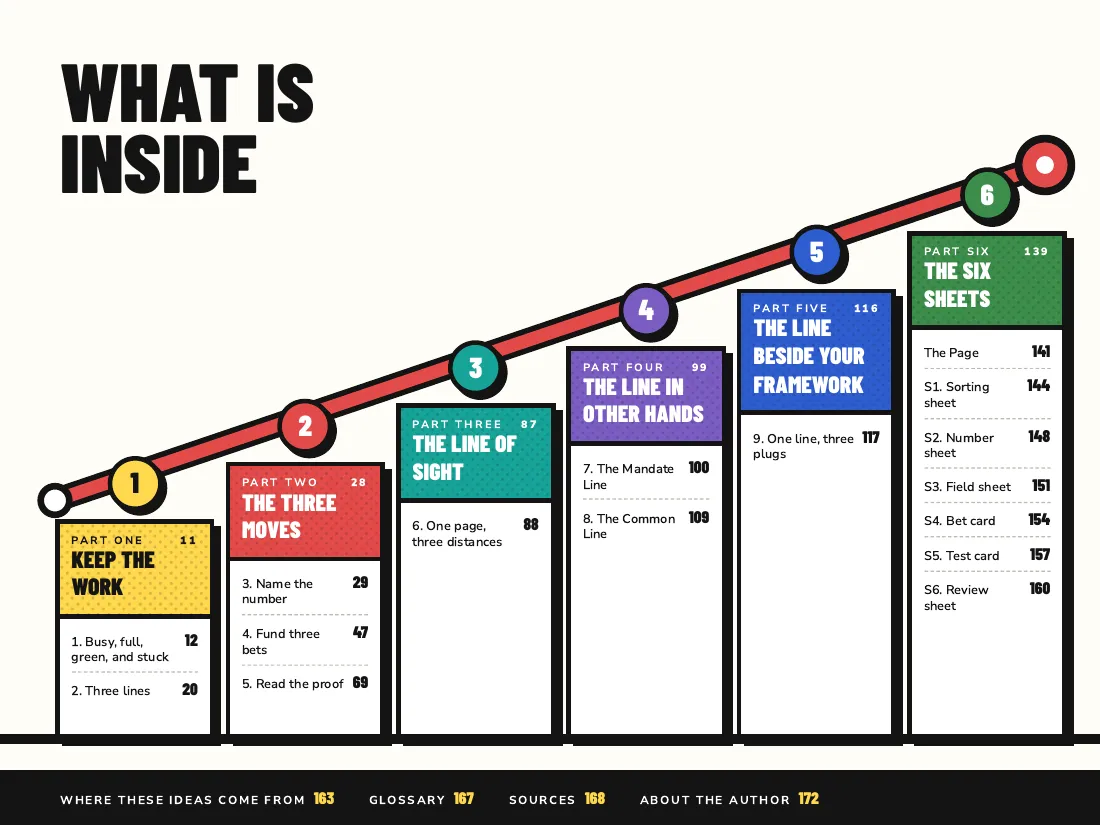
What is in the book
- Part OneKeep the workChapter 1. Busy, full, green, and stuck. Chapter 2. Three lines.
- Part TwoThe three movesChapter 3. Name the number. Chapter 4. Fund three bets. Chapter 5. Read the proof.
- Part ThreeThe Line of SightChapter 6. One page, three distances.
- Part FourThe line in other handsChapter 7. The Mandate Line. Chapter 8. The Common Line.
- Part FiveThe line beside your frameworkChapter 9. One line, three plugs.
- Part SixThe six sheetsThe Page. S1 Sorting sheet. S2 Number sheet. S3 Field sheet. S4 Bet card. S5 Test card. S6 Review sheet.
- Back matterWhere it comes fromWhere these ideas come from, glossary, sources, and about the author.
About the publisher
The Money Line is published by Peirsson Strategic Management Services, a registered sole proprietorship in the Philippines. The method comes from the firm’s own strategy work. Our principal consultant leads strategy at a multi-billion-peso financial institution, is on the faculty of the University of the Philippines Open University, and has taught more than 1,000 student-entrepreneurs. The work also draws on an MBA from UP Diliman, doctoral study in public administration at UP NCPAG, and project work for DTI, DILG, DAP, and USAID.
Questions
When is it out?
In January 2027. The founding list hears first, and reads Chapter 1 and Lesson 1 of the course free now.
What format will the book be?
A PDF, with a phone edition as well, so it reads on a phone, tablet, or computer. The Page and the six sheets come as fillable PDF forms and in PowerPoint.
What are the course lessons like?
How the Money Line Works has 9 self-paced lessons with interactive exercises. Lesson 1 opens free when you join the founding list; the other eight open with the book in January 2027.
Can my whole team use it?
Yes, within one organization. The method and the sheets may be copied and used freely inside a single organization.
Is there a print edition?
No, not yet.
Are the cases real?
No. The e-commerce business, the restaurant, and the financial institution are hypothetical. Their figures are modeled on real organizations of the same kind and size, then renamed and adjusted. The book claims no results, and you supply the proof with your own numbers.
Start with Chapter 1
Keep the work. Change the number.
The book is out January 2027. Leave your email and Chapter 1 and Lesson 1 open free today. Try the practice exercises, or scope a workshop if you want a facilitator.